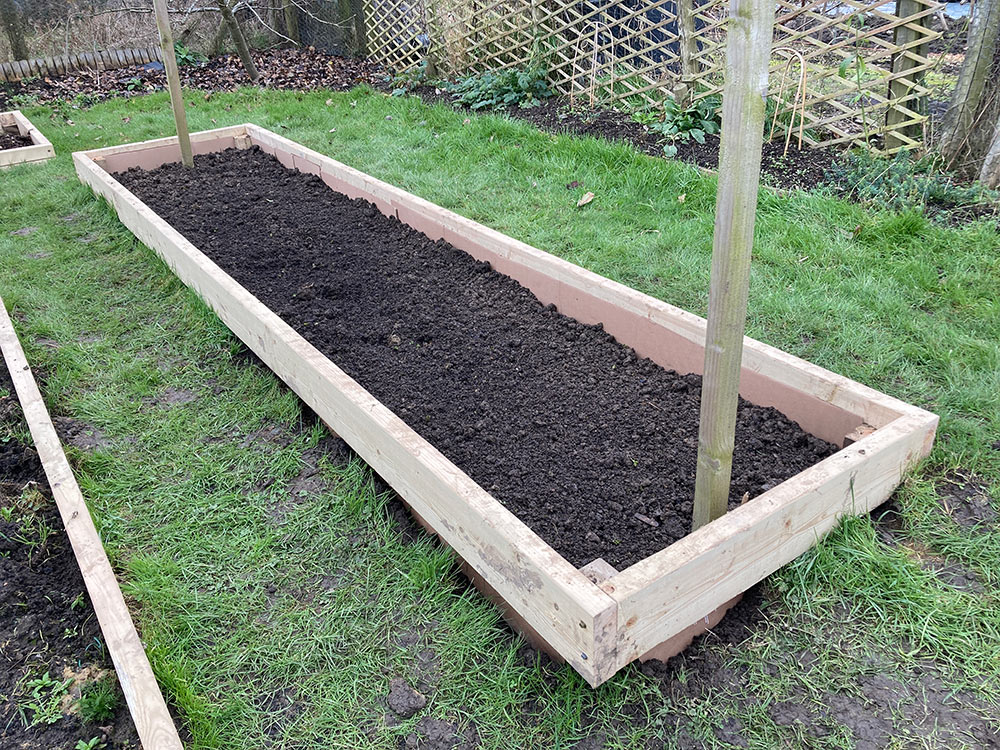
Bed 9 was my focus this morning and I turned the clay-ridden, weedy bed into a weed-free, level one. I did cardboard edging all the way round, which has taken care of gap which will get more wood in the spring.
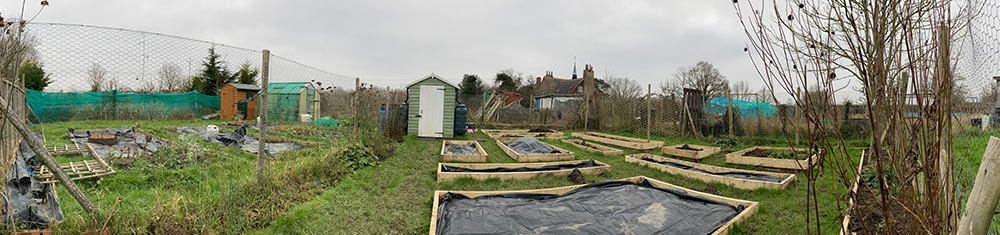
Bed 9 was my focus this morning and I turned the clay-ridden, weedy bed into a weed-free, level one. I did cardboard edging all the way round, which has taken care of gap which will get more wood in the spring.

I was going to edge Bed 1 with cardboard, but it quickly became clear that it’s not really possible once the bed is at all filled. It needs to be the first step. Fortunately I don’t think it’ll really be a problem in this bed, and I’ll keep an eye on it in case anything needs a squirt of weedkiller.
I pretty much weeded the bed and removed some clay. The big verbena has been moved into the clump in the left border. Making the hole at least allowed me to take out a bit of couch grass root.

I’ve covered the bed with a thick layer of newspaper and put the plastic down too. The beds have been made a bit narrower thanks to the thickness of the wood, but I don’t think it’ll be a problem. I’ll open this bed as soon as it’s feasible to build its layers of leaf mould, manure and compost. The manure is super cheap at the moment, so I’ve bought another 8 sacks.
I’ve bagged up some of my clay piles so that I don’t keep walking on them and they don’t slowly merge back into the garden.

We did lots of logistics today and got all the scavenged cardboard down to the shed, along with my new plastic tiles for avoiding the mud, a bucket of hügel sticks, and the bags of leaves from Normandy. Bad road signage and a closed road included, we also picked up 3 bags of compost (still frozen!) and 4 bags of manure from the garden centre.

I pulled back the plastic on Bed 1 and scattered hügel sticks across the wet cardboard. I’m not 100% sold on them, but I think I’ll stick with it (ha ha) for the remainder. I was concerned about the depth of the beds, having put cardboard down, so further reading assures me that it’s a temporary layer. It’ll decompose in time and be soft enough for roots to grow straight through.

The manure turned out to be absolutely perfect stuff (and only frozen in the middle!). It’s fine, rotted chippings and feels like the perfect base layer for the beds before I add leaf mould and compost. It was also discounted, so I need to get lots more!

I put 4 bags onto Bed 1, which I think will do for now. Then leaf mould and compost, with maybe more compost in the spring. The moment I walked away, the two robins turned up to see what was happening. I’ve covered it up again now, so I’m not taken by surprise by any mean weather elements.


The water has receded somewhat after some clear days (but loads of rain yesterday), but it’s still pretty wet, particularly around the shed. We levelled Bed 6 (the worms had made an aerated raised section in the middle) and laid a thick layer of newspaper down and then put the plastic back. That’s now done for spring, when the grass edges will be cut back, cardboard edges and base added. Then sticks, manure, leaves and compost.
Bed 2 has also had more newspaper added to it, and the very end is now covered too. The original newspaper was sopping wet, so it’ll be interesting to see what survives until spring. At that point, I’ll uncover it all and see what weeds remain.

Bed 5 has now been put away for winter. A layer of leaf mould has been taken from the bin, then compost on top. In the spring I’ll add more manure and compost to bring up the level. For now, it’s covered in plastic and done.


We’ve covered the whole of Bed 1 with an overlapping layer of cardboard. The cardboard edging will be done later – but I’m out of cardboard now! Meanwhile, the plastic is back on.


My two robins were back today, having been AWOL for a few visits. One is still braver than the other and is the one who is happy to take mealworms from in front of the shed, while the other one sits up on the fence.

I put all my energy into the smallest bed, Bed 5, in order to try out the full process. I removed the huge piles of clay and the weeds. The poppy that was somehow still alive has been moved to Bed 3 – somehow I managed to avoid the bulbs. I edged the inside of the frame with cardboard and filled the post holes that were somewhat cavernous. As I dropped balls of clay and soil down there, I could hear them hitting water.

The hard work was dragging a third of the soil back at a time and laying cardboard before re-covering it. I’m not entirely sure if I’m going to do this for all the beds; maybe for some I’ll do the more traditional thing of simply putting cardboard down on top of what’s there. But I’ve done some good work on my soil.

The next thing will be leaves and compost; this one isn’t big enough to get hügel sticks as well. Then it’ll be covered in its plastic until spring.


The standing water had receded, but the ground is still very wet down at the plot. Since time is passing, but the weather means that I can’t do proper work down there, my priority is (also) at least keeping the progress I’ve made. So I cleared the clay and few weeds from Bed 1 and managed to cover it on my own (hurray for it being a single sheet.)

I managed to move the big verbena and stick it in among the verbenas in the border.

I also made a bucketful of improvement to the remaining unweeded section of the left border and pulled up long grass and clumps of grass and cress. Although it still doesn’t look great, it’s a huge improvement.

I finished edging the outside of the fence with the wooden edging. I’m not sure how effective it’ll be, but it’s worth a go at reducing the impact of the grass from outside. Still not sure what to do about all the grass from the neighbouring plot.

Bed 2 was my focus today, but I did some other odd jobs too, like finally changing the bungee cord on the shed door and better covering the pile of compost in the middle bed.

The plot was under water in a number of places and very muddy everywhere. I managed to weed Bed 2 a bit just by carefully pulling stuff out, including buttercups and their long roots. I evened out the soil and then laid a double layer of newspaper and thin cardboard / thick paper.

I then pinned the black plastic over the top, but not too firmly, in case I feel like adding more newspaper later on.
I had scraped off lumps of yellow clay from the bed and from other beds too. That’s just an ongoing job, trying to clear up what’s been dumped.


It was a very frosty morning, which meant that the ground was too hard to do any weeding, digging or moving. Mum brought down a couple of new sacks of compost and changed the suet coconut.
The hard frost meant gave good proof that the coreopsis is indeed hardy and must have been there for more than one season. It’ll be nice to see it next summer, supported by the edge of the bed, rather than sprawling over the grass.


I found one job to do and filled in the hole at the front of the front bed, lining the depth with lumps of horrid clay and then leaves from my bin, before filling in the rest with compost.
Most of the visit was spent documenting exactly which jobs need to be done to which beds. I also took a good photo of each bed, so I can refer to them at home. There are a couple of beds that it would be good to do some small-scale work to and then cover them until the spring, giving the weeds a good chance to die. I can’t do weeding now that the ground is so saturated. By the end of my visit, the frost was thawing and I was skidding about in the mud again.
It really hit me today, how much work I have ahead of me. Getting these beds back into working order is going to be a huge job.

I’ve done about half the length of the outside of the fence, putting down edging pieces in the trough between the fence and the grass. The grass will still come through, but I hope to at least slow it down. The grass that I took out from under the frames was already certainly weakened.

The two robins were back and it was when they sitting on neighbouring fenceposts that I realised that I’d forgotten my phone. So I went back home for it, the first frustration of tools never being where I wanted them today. This is the closest I could get them together, but they were back following me around. My guess is that the one in the bed is the usual one and the one on the shed is the newcomer.

Along with the realisation of the work ahead comes the decision to put an inner edge of cardboard around all the beds. Even if the beds haven’t been put on grass, I want put up the best defence possible.
With all the clay removed and the plants tidied and fluffed up, I put 10 Hotpants pink and white tulip bulbs in the front left corner, and filled the rest of the gaps with 20 mixed double narcissi bulbs. On top went a whole bag of Levington’s compost, which turned out to be absolutely lovely stuff. Let’s hope it stays good for more beds and next year’s pottings.


I’ve made a start on tidying up Bed 3 first, as it won’t get covered and needs some bulbs planting in it very soon. It’s a bit of a mess where earth and clay have been heaved onto the bed and plants during the hole digging process.

The good news though is that I suddenly have two robins in the plot. They’re not getting aggressive with each other, so let’s hope that they might move in to the nest box behind the apple tree.

This frame had been put down onto the grass, which I don’t want heading straight into the bed, so I cut it away and pulled it out. I’ve then put a section of cardboard in at the edge to keep a barrier and to allow me to fill the bed. Very hard work.

I’m gathering the clay I take off the beds and putting what I can into place that don’t matter. For example, the sometimes over-sized post holes and the front of the front border, which now has a big trough that needs filling.
Not enormously visible work, but the recovery of the grass in one week is pretty impressive.

